
Venue Preview: Documentary puts spotlight on Massachusetts Avenue in Cambridge
The documentary shows at noon on Sat., February 7, 2026 at the Venue in Lexington Center. There will be a Q&A after the film with Federico Muchnik.
The Venue
1794 Massachusetts Avenue
Lexington, MA
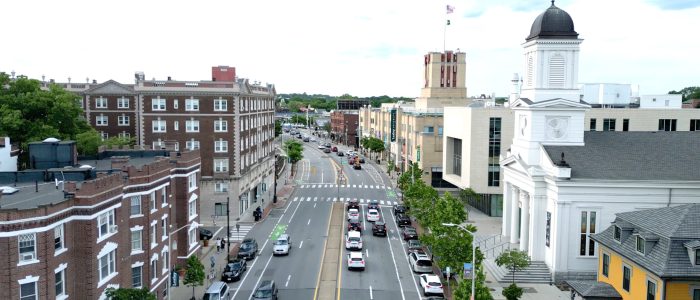
S ometimes you see something every day, so you don’t really see it. If you stop by the Venue for a showing of a documentary by local filmmaker Federico Muchnik, you may see a stretch of Massachusetts Avenue in Cambridge in a different light.
“Being a longtime Cambridge resident, I was nevertheless kind of blind to the whole idea of taking a localist approach to filmmaking. My films had always been out there or reaching for other things. Then a book by a Lexington (author) Robert Putnam, called Bowling Alone, was made into a film called Join or Die (2023) by Pete Davis. Pete Davis is an author who wrote Dedicated: The Case for Commitment in an Age of Infinite Browsing. That book and that movie on Putnam and that conversation with Pete really sharpened my lens. Sharpened my focus on localism, getting to know my neighbors, getting to know the people of the street, wanting to know how the barber shop guy got to where he was, engaging with the community, the fabric of the community.”
Still, he didn’t know how he’d use his local lens.
Before he started filming, he says, “I sat down with a Google map of Cambridge, and I went from Alewife to MIT, and I scanned all the businesses, and I saved the businesses that sort of jumped out at me. And that was a kind of an attempt to say, well, this is going to be very methodical, when I didn’t realize that making a documentary is a process of discovery, it’s a process of research, it’s a process of luck.”
Filming started in early 2024, and Muchnik let what he chose or saw shape the film. For instance, he says, “Over those eight months, I knew that I couldn’t make a documentary on myself without a piece on Mr. Bartley’s Burger Cottage (in Harvard Square), where I used to bus dishes when I was 15…So I went into Bartley’s, I ordered a burger, and I got to know the manager. I interviewed her, interviewed the chef, with my iPhone, had a beer, had a burger, and shot some B roll. And then I said, thank you very much. And there was my scene.”
He realized this would be a “process of research, process of discovery, a process of luck (and) there were many happy accidents along the way.”
Local landmarks yielded some surprising scenes. Muchnik says, “I couldn’t make a film about Mass. Ave. without doing a piece on Andy’s Diner in Porter Square…it turns out that Kelly, the waitress who’s in the (movie) poster, who’s just a charming woman, gave me gold. I couldn’t have asked for better. Ditto for the bus driver, Tony Raymond, who opens the film.” Muchnik says he just asked Raymond, who was driving his route, to agree to be filmed, and Raymond has now attended each screening since its premiere in October 2025.
Muchnik says he was “instilled with a political bent, or at least a political lens,” by his experience living in Cambridge. Born in Rome to Argentinian parents, he was raised from age of five on in Cambridge by his mother Rita Arditti who helped open a feminist bookstore in Cambridge in the early 1970s called New Words,
He went on to film school at New York University, worked as a producer at local public television station WGBH, and even was cast as the lead in a film The Golden Boat, which showed at Sundance and other film festivals in 1991. “That was a nice little sort of feather in my cap in the art cinema world anyway,” Muchnik recalls. His career has included stints teaching at Boston University, Emerson and Lesley Universities, and publishing a book on film production.
He started to notice how filmmaking was changing. As he puts it, in the early aughts, “I’m finding myself just surrounded by this industry of iPhones, smartphones that just do incredible work.”The iPhone worked well, because, Muchnik says, it’s “an unobtrusive piece of gear that is disarming.” Once he started to just go places, he thought were interesting along Mass. Ave., his film took shape.
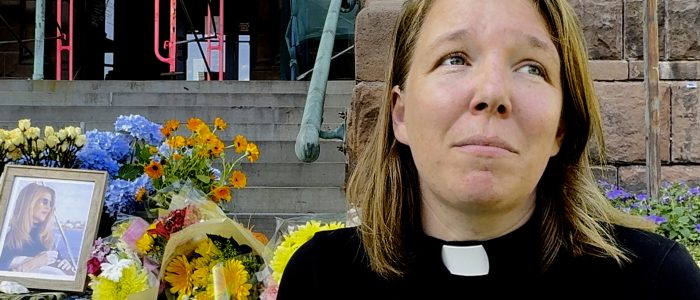
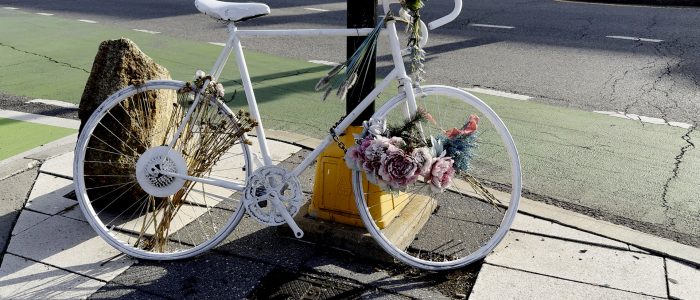
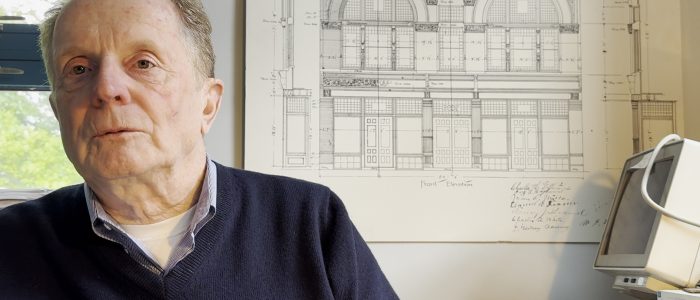
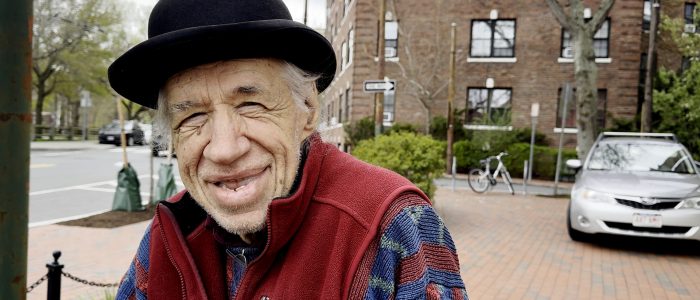
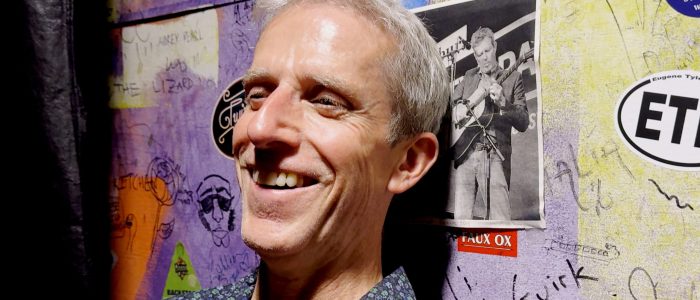
There are many stories in the film, and each is a “package” as Muchnik says. There are people at a dance studio, rhumba, salsa and belly dancing. There is a person who leads ceremonies at ghost bike memorials, the sites where cyclists have died. There is a barber, an author giving a reading at Harvard Bookstore, a person in a wheelchair tending a garden outside the Christian Science Church. There are scenes about urban planning for a proposed apartment building near Porter Square.
Each segment within the film is usually only a few minutes. “An audience in a room collectively is much smarter than an individual,” says Muchnik, so he keeps the camera and stories moving. However, he says when he interviewed “a couple of homeless people on Central Square…I purposefully let things drag a bit…I didn’t want to step on some of those pauses. I wanted those pauses to be there, and I wanted a certain sense of discomfort in the audience’s mind for that particular scene, so that they can empathize with Lisa, a really troubled, homeless person living on the street.”
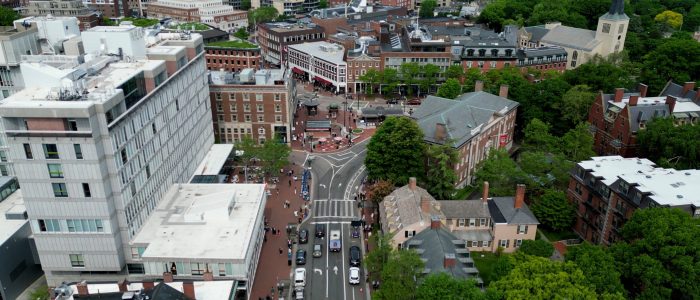
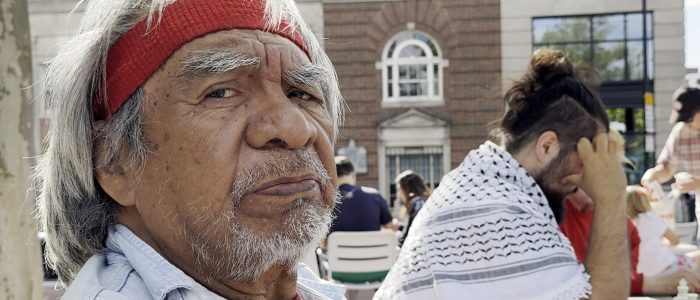
Muchnik looks at the “Ave.” as he sometimes calls it, very close up, but also takes a sky-high view. He uses a drone that follows this main corridor through Cambridge. He began filming in spring 2024, so he has some overhead views of the student encampments at Harvard and the Massachusetts Institute of Technology. Allowed into MIT’s encampment, he spoke to pro-Palestinian cause students. He also spoke to a student wrapped in the flag of Israel and edited the film to give each student equal time to speak about their experience on campus at that moment.
Muchnik ends the documentary with a nighttime dance party in Central Square, saying, “I think that’s a really good note to go out on.” He hopes viewers see how one street tells a narrative, and “That story is a story of life, culture, activity and the importance of community along this artery, and” he also thinks “most people come out of the film saying, ‘Geez, I had no idea” all of this was happening.’” Of this street that connects Cambridge all the way through Lexington, Muchnik says, “Mass. Ave. just keeps giving.”
Ken Hastings adds, “We’re all pleased here at the Venue that Federico reached out to us. Many of our offerings come to us this way and we try to do what we can for the community and local filmmakers.”
The documentary shows at noon on Sat., February 7, 2026 at the Venue in Lexington Center. There will be a Q&A after the film with Federico Muchnik.
The Venue
1794 Massachusetts Avenue
Lexington, MA