
Building Strength After 50: How Strength Training Is Essential to Aging Well
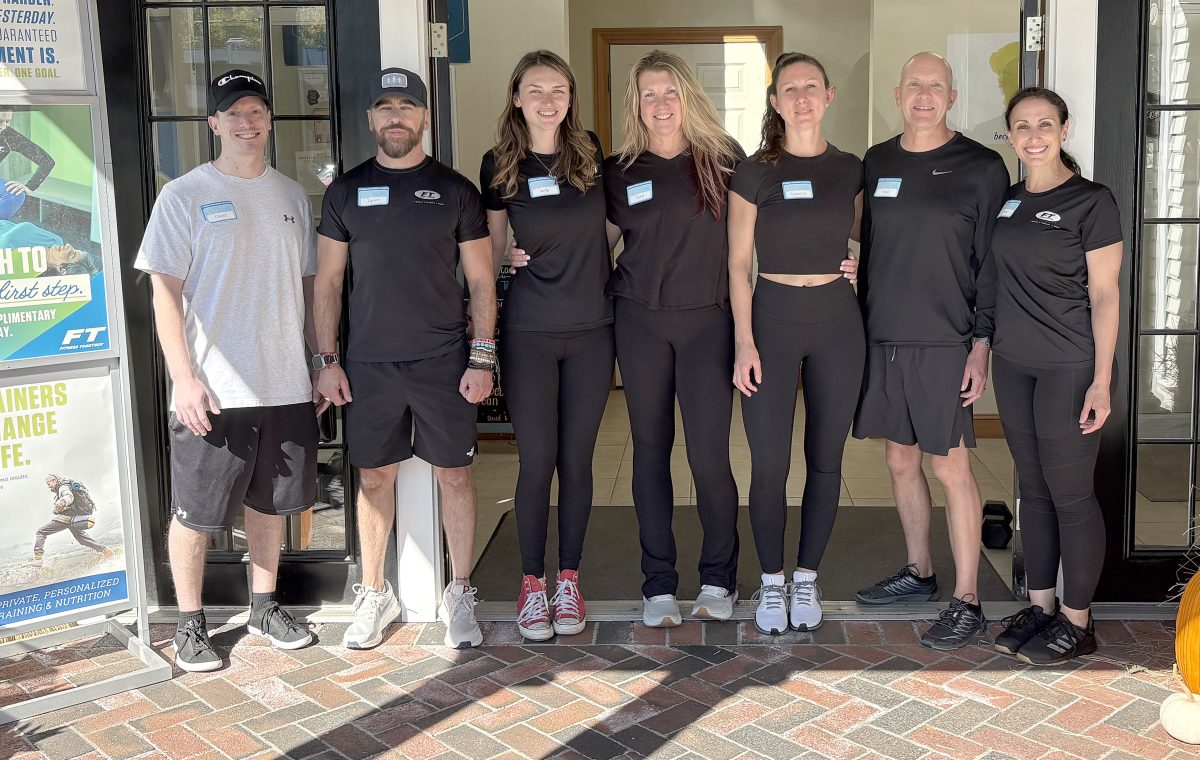
D rop in any day at Fitness Together in Lexington, and you’ll find clients in their 50s, 60s, and beyond practicing dead-lifts, hip hinges, and balance drills in their individual training rooms. There’s no thumping soundtrack or crowded classes. Instead, the entire studio hums with quiet determination as each client works through a program designed specifically for their body, fitness history, and goals.
For owner Kerri Powers, this scene never gets old. She has spent more than two decades watching clients discover something many were never taught to believe: that strength—not dieting, not aesthetics, not the pursuit of youth—is the foundation of aging well.
“We meet clients where they are,” Powers says. “Everything we do is individualized—no big classes, no guessing. Our mission is to help people of all ages build strength, move better, and feel confident in their bodies for the long term.”
With 2026 ahead of us, you may be considering an exercise program. Consider a program designed to address your personal goals, taking into account any past injuries and lifestyle considerations, and focused on enhancing your daily life now and into the future.
Muscle Loss After 50, Especially In Women
Most women know they “should” exercise. Far fewer understand how dramatically muscle loss accelerates with age. Research from the National Library of Medicine shows that women lose 3–8% of muscle mass per decade after 30, with the decline speeding up after 60. This loss—known as sarcopenia—is one of the leading contributors to falls, fractures, and loss of independence (https://pmc.ncbi.nlm.nih.gov/articles/PMC2804956/).
Layer in the rise of GLP‑1 medications for weight loss, which can accelerate muscle loss, and the stakes become even higher.
Powers sees the consequences firsthand. “Fitness after 50 isn’t about aesthetics,” she says. “It’s about strength, balance, bone health, mobility, and energy.”
Science backs her up. MIT News highlights research from Dr. Miriam Nelson, a pioneer in strength training for older adults, showing that even frail seniors improved basic daily functions—like walking to the bathroom—after beginning resistance training. Nelson began this research as a graduate student at Tufts in 1983 and continues to encourage women through her books, research talks, and other work to recognize that strength training is essential for a healthy life (https://news.mit.edu/2001/nelson-1114).
A Smarter, Safer Training Model
At Fitness Together, every client begins with a Fit Evaluation and a mini‑workout. Trainers assess mobility, balance, strength, and movement patterns before designing a personalized plan. The emphasis is on functional movement—squats, hip hinges, pulling exercises, core stability, and balance work—because these are the movements that keep people independent.
Nutrition is woven into the process as well. “A healthy diet supports strength and recovery,” Powers explains, emphasizing adequate protein, whole foods, and hydration. Many FT trainers hold nutrition certifications to help clients build sustainable habits.
Powers began as a trainer when the studio opened in 2003 and became owner in 2006. She has worked with every age group—from kids to older adults—but says the transformation she sees in women over 50 is especially meaningful. “It’s about feeling capable, confident, and independent in everyday life.”
Emerging research suggests the benefits extend beyond the body. A Tufts University article reported that older women with mild cognitive impairment who participated in resistance training significantly improved their memory and cognition scores (https://www.nutritionletter.tufts.edu/healthy-eating/weight-mgmt/weight-lifting-could-pump-up-your-brain/).
Local Stories from the Studio
The results Powers sees aren’t abstract—they’re lived.
Kathy Bono joined in 2017, hoping to improve her health. Today, she trains three times a week and has lost weight, increased her mobility, and boosted her energy. “FT is truly my ‘happy place,’” she says. “Every session is a positive experience, and I feel energized afterward.”
Mike Leary has been training at FT for 18 years. What began as a way to carve out time for exercise became a long‑term commitment to strength and balance. “The trainers are knowledgeable and supportive,” he says. “The owner ensures consistency, tenured staff, and a clean facility.”
Barbara Hughey, now 65, started training around 2003 because she knew she needed accountability. “If I signed up for a regular gym, I might not go,” she says. Twice‑weekly sessions helped her build strength—so much so that one trainer once called her “one of the strongest women there.” She recommends FT for its structure and the relationships she’s built with trainers who genuinely care about her goals.
During the COVID 19 epidemic, FT transitioned to online fitness training. Many clients have stayed with the online model for convenience. Some of their clients, like Barbara, find that it really has helped them to stay active as they age.
These stories share a common thread: strength training works, and it works at every age.
Beyond the Studio: A Community Approach to Bone Health
Powers also teaches OsteoFitness at the Lexington Community Center, a long‑running program created by Beverly Ikier for individuals with osteopenia and osteoporosis. The class focuses on bone‑safe strength training, balance, and posture. It meets Wednesdays and Fridays at 10 AM, both in person and on Zoom, in 12‑week sessions.
The Bottom Line: It’s Never Too Late
For many women over 50, Fitness Together is the first place where exercise feels safe, effective, and sustainable. And for Powers, the message is simple: it’s never too late to start.
“We see clients make meaningful gains in their 50s, 60s, and beyond,” she says. “The hardest part is getting started.”
Lynne & Kathy
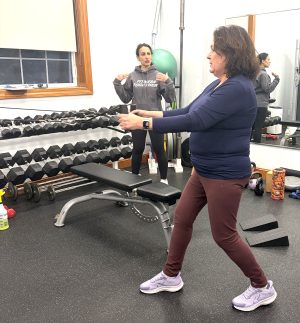
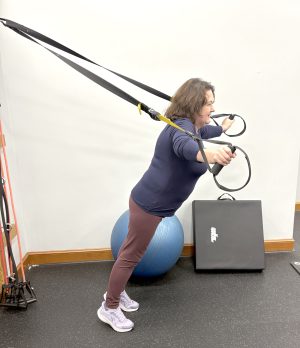
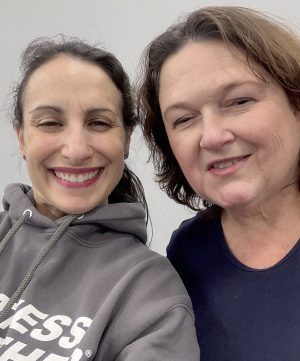 KATHY is trained by Lynne Hajjar and has been with FT for 9 years now. She is a Senior Manager for a Global Company, and her position requires her to sit at a desk working on a computer for most of the day. Her position is high-functioning and often very busy. She trains at our studio 3 times per week each session incorporates full body movement. Standing and stabilizing with her body during sessions works to maintain the overall strength and stability of her spine and core. This helps Kathy to manage and maintain her overall physical and mental well being for daily life. Kathy calls FT her “happy place.” And the FT staff say her presence makes them happy as well. “Not only is she a dedicated client, a joy and privilege to train, she has also become our friend over the years,” says her trainer Lynne Hajjar.
In Photo 1 – Kathy is performing a split stance bilateral row with the functional trainer. This exercise assists with strengthening the back muscles in the thoracic spine which support better posture and proper shoulder positioning.
In Photo 2 – Kathy performs a Chest Fly on the TRX Suspension Trainer. This exercise strengthens the chest, front of the shoulders and biceps and by utilizing the TRX she is also engaging the core and shoulders for stability.
Taylor & Mike
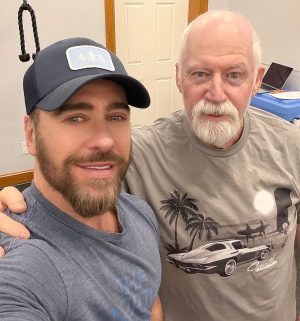
MIKE has been a client of FT for 18 years. He originally wanted help with strength, balance, and flexibility to allow him to keep up with the physical aspects of his work. Mike owns Leary Contracting, Inc. in Lexington. Over the years, he’s gained knowledge, improved his fitness, and now feels in control of his health. It’s been a steady, rewarding journey for Mike.
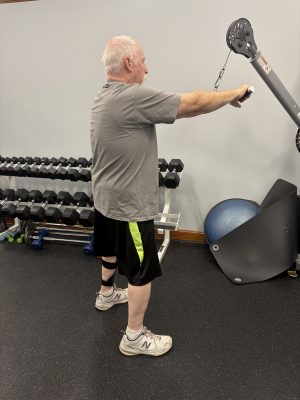
In Photo 1– Mike is performing a wide-grip pulldown on the functional trainer. This exercise is excellent for strengthening his latissimus dorsi muscles while improving the posture and alignment of his shoulders and neck.
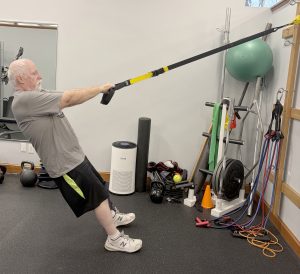
In Photo 2 – Mike is performing a close-grip TRX row, a great exercise for strengthening the upper and mid-back, including the lats, rhomboids, and biceps. This movement also reinforces good posture by encouraging proper shoulder positioning and core engagement.
Fitness Together
433 Marrett Rd
781-862‑1175
www.fitnesstogether.com/Lexington
Visit the website to schedule a FREE
fitness evaluation