
LHS Grad Leads Startup Offering Hope for Better Burn Care
Innovation Sprint team SilkMed is looking to revolutionize the burn wound industry with proprietary sprayable silk-based technology.
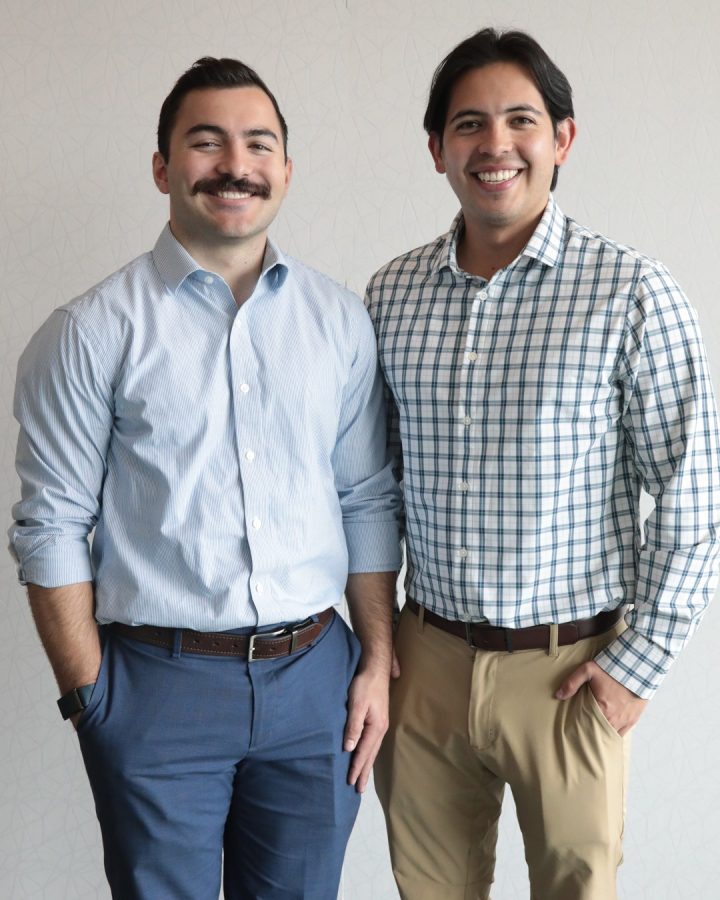
“This provides us with complimentary office space for nine months, along with invaluable mentorship and investor exposure – it’s a great example of how the local ecosystem supports impact ventures,” said Useche. Speaking by Zoom, he and DiMuccio shared their vision for developing an innovative sprayable wound-dressing technology based on proteins derived from silk, that they see as having the potential to transform the field of burn care.
Nearly ten years after his Lexington High School graduation in 2016, Useche looks back on his Junior and Senior years there as “incredibly formative.” As an immigrant from Ecuador – his mother is from Ecuador, his father from Colombia – after his family settled in Lexington in 2014, he found at LHS “a community that was both globally-minded and academically rigorous,” he said. Daniel Abramovich’s Physics class solidified his passion for the hard sciences and reinforced his decision to pursue a bachelor’s in engineering.
After earning a BS in mechanical engineering at Fairfield University in Connecticut, Useche worked for a few years in operations at a life sciences firm. “But I always had this itch that I wanted to start my own business,” he said. He found a pathway to broadening his skills in a Tufts University program designed to give people from STEM (Science, Technology, Engineering and Math) backgrounds training in business development and administration, the Master of Science in Innovation and Management (MSIM) at the Gordon Institute.
A key part of the MSIM curriculum is the Innovation Sprint, in which student teams identify key problems, develop prototype solutions, and work out business and financial models. SilkMed evolved from a project Useche and four fellow students created after being inspired by prototypes of a sprayable wound dressing developed in the Tufts Kaplan Lab, headed by the distinguished biomedical engineer and Tufts University Professor Dr. David Kaplan.
As part of their research, the team visited the burn unit at Mass General Brigham Hospital, Boston. “I got to see firsthand the painful recovery process that patients face after the traumatic injury of a severe burn,” said Useche. Many patients, doctors and nurses mentioned the suffering caused by repetitive dressing changes, using the standard treatment of antimicrobial ointment covered with a non-adhesive gauze. Hearing from patients about braving those dressing changes “just seared in my mind the notion that this technology can really change lives,” said Useche.
The SilkMed Sprint team won second place in the Healthcare & Life Science track in the 2024 Tufts $100k New Ventures competition. Useche officially founded SilkMed as a company in July 2024, as a spinout startup licensing the relevant technology from the Kaplan Lab through the Tufts Technology Transfer Office.
After his original Sprint teammates pursued other professional avenues, Useche found a new collaborator and partner in Zachary DiMuccio, also an MSIM graduate, with a background in biomedical and electrical engineering. “Sebastian was my TA for my finance class,” said DiMuccio, “and that’s how I learned what he was doing.” The two developed a close working relationship throughout 2025 and DiMuccio officially joined SilkMed as Chief Technology Officer (CTO) in October.
In December 2025, Christopher Taylor joined the company as part-time Chief Operating Officer (COO), bringing over two decades of experience in biotech leadership. SilkMed is currently finalizing contracts with a range of experts in fields from business strategy to clinical practice, including Dr. David Kaplan, who will form an Advisory Board.
Boosted by a $50K grant from the National Science Foundation Innovation Corps in fall 2025, two grants totaling $25K from the VentureWell E-Team program, that supports student-led startups, and by promising results from pre-clinical animal trials of the spray-on wound dressing technology, Useche and DiMuccio have a busy year ahead.
“Right now, we’re in the pre-seed round, and we’re raising half a million dollars,” said Useche. The team will move forward on three fronts; working closely with the Kaplan Lab to refine the technology, preparing to pursue clearance from the U.S. Food and Drug Administration (FDA), a necessary hurdle to clear on the way to clinical trials, and reaching out to potential investors.
Useche and DiMuccio are optimistic realists about the road ahead, forecasting a three- or four-year time lag before they have a product ready for use with patients. “We aren’t making clinical claims yet, but we are very excited about the potential impact suggested by our research,” said Useche.
