
“Democracy Isn’t Born — It’s Built”: Martha Minow on Fear, Education, and the Fragile Architecture of America’s Constitutional Order
Not Born a Democracy: Preconditions for a Constitutional Republic
Martha Minow
April 11, 2026 at 8PM
Martha Minow has taught at Harvard Law School since 1981 and served as Dean from 2009-2017. She’s an expert on constitutional law and human rights who continues to serve on many boards and commissions, earned countless honors, and has written nine books, with a tenth in progress.
Her most recent book is Saving the News: Why the Constitution Calls for Government Action to Preserve the Freedom of Speech (2021). Her other books include When Should Law Forgive? (2019), Between Vengeance and Forgiveness: History after Genocide and Mass Violence (1998), and Making All the Difference: Inclusion, Exclusion, and American Law (1990). Professor Minow chairs the board of Massachusetts public media (GBH) and serves on the board of other philanthropies, including the Carnegie Corporation and the SCE Foundation. Minow previously served on the Center for Strategic and International Studies Commission on Countering Violent Extremism and on the Independent International Commission Kosovo. She helped to launch Imagine Co-existence, a program of the U.N. High Commissioner for Refugees, to promote peaceful development in post-conflict societies. She has led commissions in many other areas.
Her many honors include the Ruth Bader Ginsburg Lifetime Achievement Award (American Association of Law Schools, 2024) and ten honorary degrees in three countries. She holds the 300th Anniversary University Professorship at Harvard.
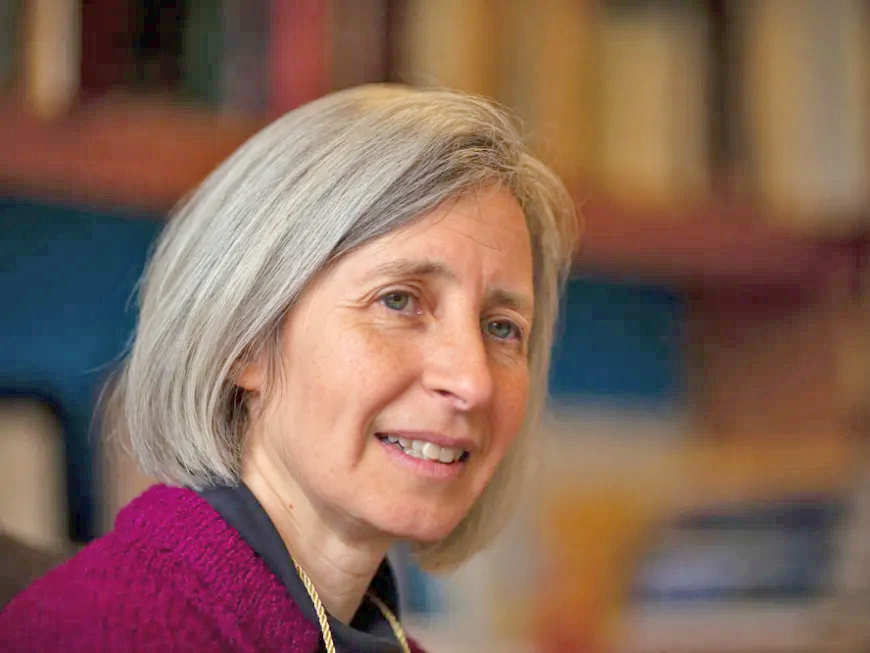
Legal scholar Martha Minow reflects on the civic habits that sustain democracy.
Martha Minow does not talk about democracy as a birthright. She talks about it the way an engineer might talk about a bridge — as something that must be designed, maintained, reinforced, and repaired. “There’s something missing in the conversations about our current crisis,” she says in a recent phone conversation, “that has to do with what are the ingredients and the preconditions for a constitutional democracy?”
Her forthcoming book, based upon her very popular paper “Not Born A Democracy,” grows out of that conviction. It also builds on her work in constitutional law and on an earlier professional association with political scientist Robert Putnam, whose 2000 book Bowling Alone became the definitive account of America’s collapsing civic life and a ‘canary in the coal mine’ for our current situation.
During our conversation, I was pleasantly surprised to learn that Minow worked closely with Putnam on what became one of the most influential civic engagement initiatives of the last quarter century: the Saguaro Seminar. A long-term project at Harvard’s Kennedy School Saguaro was aimed at understanding America’s “social capital” — the trust, networks, and civic habits that allow communities to function (Harvard Kennedy School¹). I interviewed Putnam for what was then the Colonial Times nearly 20 years ago. In Lexington, we were already witnessing a decline in civic participation and volunteerism.
“He [Putnam] created this seminar called the Saguaro Seminar, named after the cactus,” she recalls. The group included bankers, community organizers, a dancer, and a young state senator named Barack Obama,” she explains. They traveled the country, listening to people, as they described the slow erosion of the small associations that once held communities together.
“We spent a year and a half traveling the country and talking with people,” she says, “and watching a kind of decline that Bob fully documented in his book.”
What struck Minow was not just the loss of bowling leagues or choral societies, but the deeper loss of civic habits — everyday practices of reciprocity, listening, compromise, and shared responsibility.
“There are two fundamental sets of ingredients,” she explains. “One is a set of institutions that have to be continually tended and repaired and renewed, but the other is a set of character and dispositional traits of people.” Without those traits — “the ability to play by rules, to deal with losses, to listen, to take turns, not to bully…and to be open to learning about the needs and interests of people like yourself and unlike yourself” — democracy simply cannot function.
In her current work, Minow has identified four preconditions for a democracy: education, reliable information, freedom from fear, and reciprocity.
THE FOUR PRECONDITIONS OF DEMOCRACY
Education: “Built-in Inequity.”
Minow is blunt about the state of American education. “If property taxes are the instrument by which you fund education, it’s a built-in inequity,”
She notes that while the framers did not include a federal right to education, “every state has a right to education in its state constitution.” But inequality is staggering. “The disparities between states remain profound,” she says. “Even within states, the variation is enormous,” she says. “Are all students equally prepared for citizenship?”
Yet she sees a glimmer of possibility in AI technology. “The opportunity for real educational equality is almost within sight,” she says. Though she maintains a healthy skepticism toward AI, she says it could be used for good in this instance.
Reliable Information: “People are thirsty, particularly for local news.”
Minow sees the collapse of local journalism as a direct threat to democratic functioning. “It’s a terrible time,” she says. “The migration of ads to online and private equity buying up chains. The bullying activity of people in public life, as well as misinformation and disinformation.”
But she also sees hope — “The hope is exemplified by small, local publications,” she says. “There are green shoots all over the country. People are thirsty, particularly for local news.”
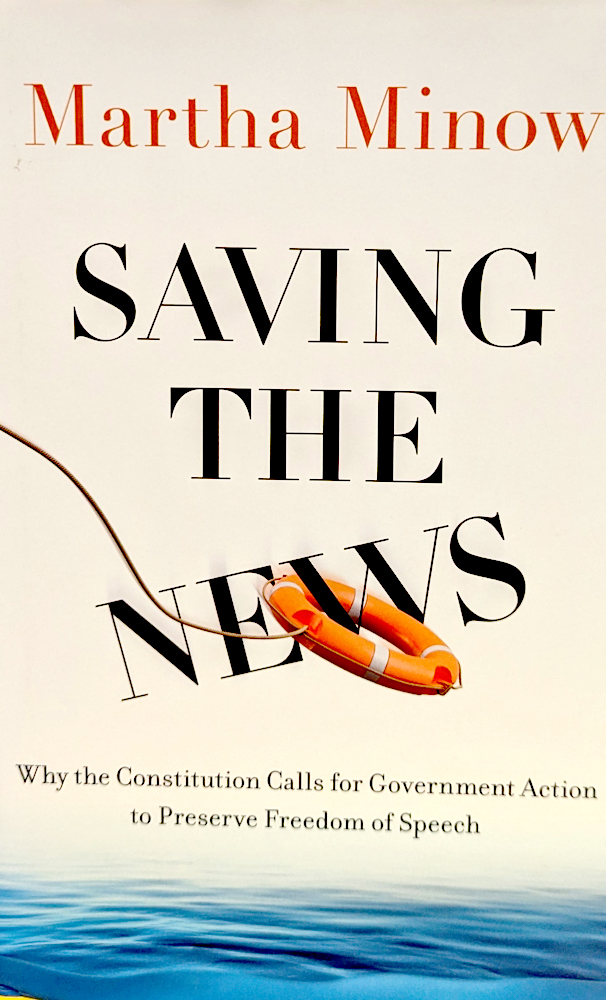
In 2021, Minow wrote a book called “Saving the News: Why the Constitution Calls for Government Action to Preserve Freedom of Speech.
Minow points to a national philanthropic effort that was launched when she was Chair of the MacArthur Foundation (she was elected in 2022 and stepped down in 2025). “Now 200 foundations have come together to form Press Forward and pool funds to assist local news initiatives,” she says, referring to the Press Forward Initiative, which was launched by the MacArthur Foundation in 2023. Press Forward is an organization dedicated to supporting local newsrooms through grants and advocacy.
For Minow, a robust media ecosystem is not optional. It is one of the pillars that holds democracy upright, and she has many recommendations in this space. Minow was elected Chair of the Board of Trustees for GBH (formerly WGBH) in Boston. She leads the board for the public media organization, which produces content for PBS and NPR. So, she has plenty of opportunity to share her experience and expertise in this time of crisis for public media.
Freedom from Fear: “Scare tactics… can derail a critical faculty.”
Fear, Minow argues, is democracy’s most corrosive enemy. “We have different parts of the brain,” she explains, “and the parts that are more primitive — that are appealed to by scare tactics — can derail a critical faculty.”
Fear affects not only voters but leaders. “It’s not just ordinary voters that are afraid,” she says. “It’s elected officials… heads of law firms… fearful of losing their clients.”
Minow warns that fear can be weaponized to justify extraordinary measures: “It is trying to create disorder in local communities to justify bringing out police, bringing out military, and declaring a national emergency and suspending elections.”
She sees similar dangers in foreign policy. “Some could say that the same is true about waging war,” she says, “to prompt a kind of retaliation that could create a national emergency and justify suspending elections.”
Reciprocity: “You really can’t keep this project underway.”
For Minow, reciprocity is the glue that holds everything else together. “If there isn’t a cultivation of reciprocity — the ability to listen, take turns, and avoid bullying — then you really can’t keep this project underway.”
Her book’s final chapter will focus on this theme that hearkens back to her work with Robert Putnam. “There is this last chapter that’s about reciprocity and about opportunity,” she says. “There’s no single answer about how to salvage and save democracy, but there’s hope in lots of different regions.”
THE CONSTITUTIONAL CRISIS
Minow’s constitutional analysis is unsparing. “No one institution and certainly no court is going to save the American democratic system,” she says. “Congress has abdicated.”
Part of the problem, she argues, is the interpretive method now dominant on the Supreme Court: textualism. The approach, championed by the late Justice Antonin Scalia, insists that judges interpret the Constitution by focusing on the plain meaning of its words as they would have been understood at the time they were written.
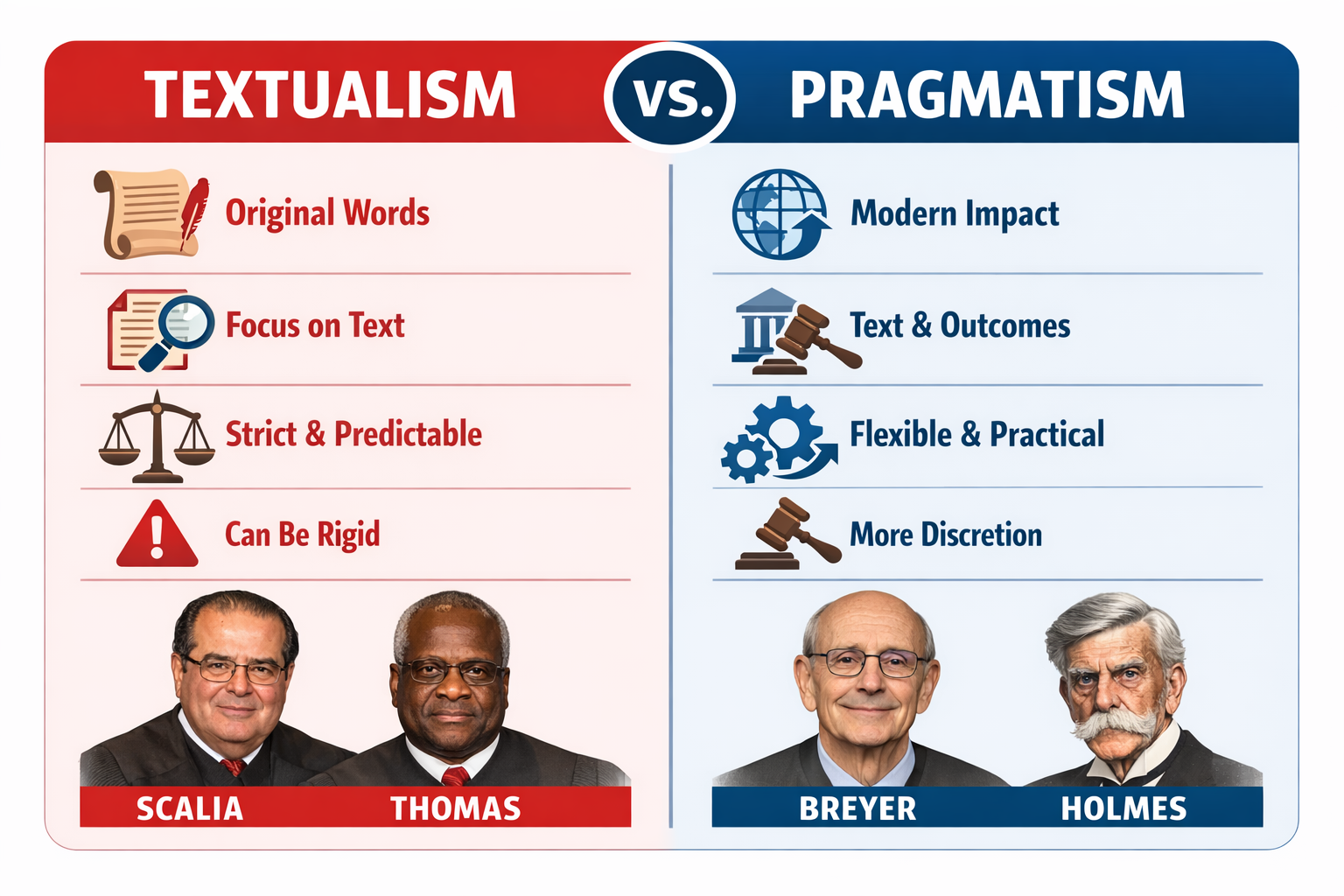 Textualists avoid legislative history, evolving norms, or modern policy consequences. They claim this method constrains judicial discretion, but Minow sees a paradox.
“The framers quite explicitly said that they knew that life would change,” she notes. “They deliberately chose broad words to be responsive to changing circumstances.” Yet textualism often forces judges into what she calls “an absurd kind of process of pretending to be historians,” especially when applying 18th-century language to 21st-century problems. “How do you have an analogy to 3D printing instructions for making a gun?” she asks.
The result, she argues, is a jurisprudence that can be both rigid and improvisational — rigid in its refusal to consider modern realities, improvisational in the way judges stretch historical analogies to reach contemporary outcomes. And all of this is happening at a moment when norms — the soft tissue of democracy — are being shredded. “We’re learning about the cost of unwritten norms,” she says.
A MOMENT OF PERIL AND POSSIBILITY
Minow does not sugarcoat the moment we are living in. “It’s a terrible time,” she says. “But there are green shoots all over the country.”
She sees them in local journalism. She sees them in communities that still believe in the public good. She sees them in the stubborn persistence of people who refuse to give up on the democratic experiment.
“This book is an effort to identify the investments that are necessary to strengthen the possibility of a vibrant democracy,” she says. “There’s hope in lots of different regions.”
And she sees hope, too, in a simple willingness to listen, to question, to reflect, and to imagine something better. That’s something we all can practice in our daily lives.
REFERENCES & FURTHER READING
Martha Minow, Not Born a Democracy: Constitutional Preconditions, 67 Wm. & Mary L. Rev. 135 (2025), https://scholarship.law.wm.edu/wmlr/vol67/iss1/4
Harvard Kennedy School, Saguaro Seminar: https://www.hks.harvard.edu/centers/saguaro
Robert D. Putnam, Bowling Alone (2000): https://bowlingalone.com
Antonin Scalia & Bryan Garner, Reading Law: The Interpretation of Legal Texts (2012): https://lawliberty.org/book-review/reading-law