
PO-SHEN LOH The Human Factor – Humanity’s future after AI
BY JANE WHITEHEAD
The Cary Lecture Series presents a talk by Carnegie Mellon University Professor Po-Shen Loh: Thought Full: The Human Advantage in an AI World.

Thought Full: The Human Advantage in an AI World
Po-Shen Loh
October 24, 2026 | 8:00PM | Cary Hall
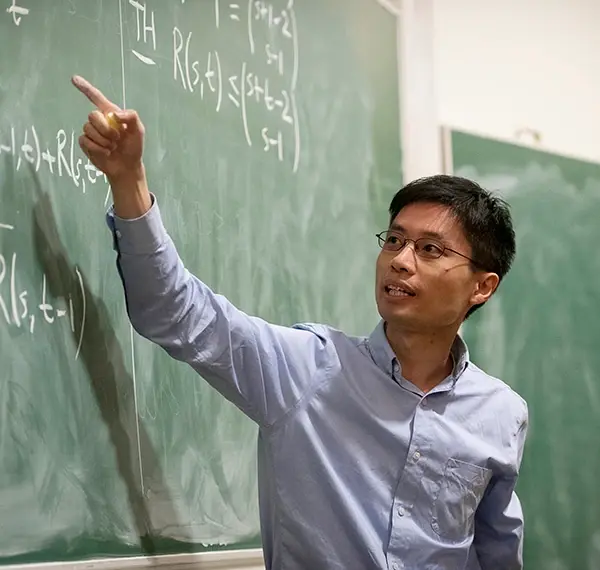
Professor Loh, 44, describes himself as “a mathematician who’s got very distracted by the real world.” A father of three, social entrepreneur, inventor and educational innovator, he coached the U.S. International Math Olympiad team for ten years, founded two popular educational math and science-focused websites and was the lead developer of a pioneering contact-tracing app during the COVID-19 pandemic.
The Human Advantage
The real-world problem that has preoccupied Loh since the launch of ChatGPT in 2022, has been “trying to figure out how to help humanity survive AI.”
With impeccable academic credentials – first in his graduating class at the California Institute of Technology, a master’s degree from Cambridge University, and a Ph.D. from Princeton University – Loh could have chosen an ivory tower existence.
Instead, he travels the country and the world meeting students, families, educators and AI innovators, hearing first-hand about their concerns and experiences. He shares a hopeful vision rooted in an approach he calls “Thought+Full.” By this he means intentionally nurturing the deeply human qualities technology cannot replace: empathy, creativity, critical thinking, courage, curiosity and caring for others.
This month, thanks to the Cary Lecture Series, Lexington will be one of many stops on Loh’s latest international speaking and listening tour, somewhere between Lagos and Hong Kong. In a rare moment between trips Lexington Times caught up with him recently for a zoom conversation from his university office/studio in Pittsburgh, Pennsylvania.
Wearing a blue T-shirt with “expii” printed on the front, the name of the popular free online math and science educational platform that he founded in 2014, Loh said that he always tries to gauge an audience’s familiarity with technology before launching into his talks.
He will often ask how many people have used ChatGPT or Claude, or Gemini, “and of course everyone raises their hands.” Then he might move on to ask about coding agents, and see fewer hands, “unless you’re in San Francisco or Seattle,” and finally ask how many use systems like Claude Cowork, that require full control of the user’s computer to complete complex tasks. So far, those have been in a minority.
“Different people in different places have touched the technology in different ways,” he said. “And roughly speaking, how concerned people are about the future correlates a lot with how much they have used the technology and see what it can do.”
His thinking has shifted recently from focusing on how on people can maintain economic relevance in the age of AI to considering how to forestall greater perils. “The biggest danger now,” he said, “is people actively using all these tools to destroy the world, or the tools themselves deciding to destroy the world.”
In a blog post on September 19, 2026, “Why do we need human mathematicians anymore?” Loh made the case that “every human industry which wishes to remain human-led after AI” should publicly adopt the fundamental axiom that “We (humans) should help humanity flourish” as a primary priority. “Every single field,” he wrote, “whether mathematics or agriculture or energy infrastructure (and certainly military and government), must be managed by humans with exceptionally strong values (a separate dimension from intelligence) in order to maintain human flourishing.” The ultimate human advantage, in other words, is our vested interest in humanity’s survival.
High Performance
Optimistic and practical in the face of such challenges, Loh has worked to develop networks of ethically-aware, smart and caring young people. Speaking at the 2024 Human Capability Initiative conference in Riyadh, Saudi Arabia, he gave a talk titled “What if Broadway Actors and Math Olympians could Transform Teaching?” In the age of AI, when most standard homework can be done by ChatGPT, “we need to think about what we’re teaching our students if all the things they are learning can be done by AI,” he said.
Connecting Through Creativity
Loh’s alternative approach to what he sees as the shortcomings of traditional math teaching, with its emphasis on rote learning and memorization, was to devise live-streamed classes for middle-schoolers, taught by gifted high-school and college students. During our zoom conversation, he showed clips from his LIVE platform showing energetic, humorous, encouraging and highly engaged instructors working in pairs to introduce math concepts and creative problem-solving to younger kids.
To find student instructors with the right combination of qualities – math skills, empathy, curiosity, and a strong desire to help other people – Loh and his team devised a stringent, multi-step application process. “We’re searching for all the kids around the entire world who have a history of actively helping people because they just like to do it,” he said.
The LIVE team looks for people who enjoy figuring things out for themselves, who are intrigued rather than panicked when confronted with unfamiliar problems. These qualities can be found everywhere, Loh noted. To get hands-on experience in elementary and middle-grade classrooms, he sometimes takes the role of substitute teacher. Introduced to the students simply as “Mr. Po,” he finds “a lot of this scrappy problem-solving all across small town America,” he said.
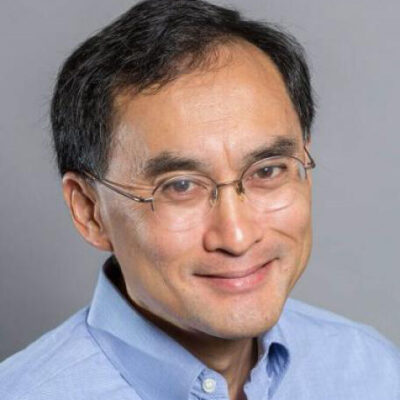 KEVIN OYE ON PO-SHEN LOH
What impressed me about Po’s perspective on AI is that as a university math professor, he sees the importance of helping children develop their innate critical thinking skills before they use AI tools. He also recognizes that the best instructors to teach children are children who just learned the material and are close in age. Research at the university level has confirmed this to be true of college students, it’s cool to see it applied at the middle school level. Po also emphasizes the importance of encouraging children to be kind to each other as teachers, to build community, connection, and collaboration, as what we need in our future leaders are people who are tech savy, original thinkers who care deeply for other humans and co-create our future.
The truly novel element of LIVE is that the student instructors are coached in real time by professional actors, comedians and theater majors, who help the young tutors develop emotional connections with their students and keep their delivery energetic and entertaining.
Loh knows firsthand that a passion for math is not enough when it comes to sparking enthusiasm in others. He was once told by a communications specialist at a public relations firm that he did not know how to talk to “normal people.” He promptly signed up for evening improv comedy classes at three Pittsburgh theaters.
Mixing with local people of different backgrounds and ages over the course of a year, and developing his comedic skills, “completely changed the way I approach communication,” he said. It also changed his approach to teaching, from a regime of rigorous preparation with a color-coded lesson script to his current mode: “dashing into the classroom with a piece of chalk, writing on the board, today we’re going to do this problem – and asking, ‘any ideas, guys and girls?’”
So far, Loh estimates that LIVE has reached around 4,000 middle schoolers, with the help of a cadre of around 300 high school and college students as instructors. “These are small numbers,” he said, “but we’re looking to multiply each of these numbers by thousands.” He sees this ecosystem of creative, collaborative, empathic critical thinkers as a promising model for building a new generation of “Thought-Full” leaders.
Higher Power
Looking around the world for leaders with potential insight into the crossover between morality and technology, Loh was struck by Pope Leo XIV’s decision to make Artificial Intelligence a priority of his papacy. The Chicago-born pope is the first math major to occupy the papal throne, and Loh speculates that this background gives both weight and urgency to his calls for action to regulate AI. Pope Leo has urged the Church to engage proactively and thoughtfully with AI’s development, stressing the need to defend human dignity, justice and labor as new technologies are integrated into society.
“I haven’t met Pope Leo yet,” said Loh, who is Catholic. But he has visited Rome several times over the last year and connected with people close to the Vatican’s AI initiative. He will return to Rome in November to take part in the 2026 Builders Artificial Intelligence Forum, a gathering that aims to “bring together the world’s most consequential voices in artificial intelligence with visionary leaders of the Catholic Church to shape AI’s trajectory for humanity.”
 THE NEXT LECTURE
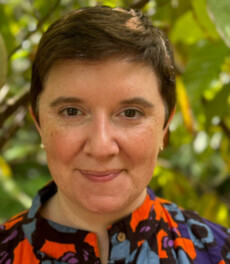 The Bittersweet History of Chocolate: What Makes Chocolate Good?
Carla D. Martin
November 21, 2026 | 8 PM
Carla D. Martin
Social anthropologist Dr. Carla D. Martin will trace the bittersweet history of chocolate –– from Mayan temples, to the Transatlantic Slave Trade, to the rise of iconic brands like Hershey’s and Nestlé, to grueling labor on cocoa farms today. For centuries, the interests of U.S. and European chocolate makers have often diverged from those of cocoa farmers and producers. As she examines the cocoa-chocolate industry, Martin highlights the often-conflicting goals that create gaps in social and environmental responsibility. Many artisanal chocolate makers today market the social values underlying their production. When it comes to chocolate, good taste is paramount, but how do we measure its social goodness, and what value does this add for consumers?
Carla D. Martin is Lecturer and Assistant Director of Undergraduate Studies in Harvard University’s Department of African and African American Studies and Founder and Board President of the nonprofit Institute for Cacao and Chocolate Research. She has published in numerous academic journals, most recently on the ethics of labor in cocoa and chocolate. Martin has received awards for excellence in teaching and research, and her public scholarship has been featured by the National Park Service, Harvard Museums, and National Public Radio. Her work brings her into community with workers at cocoa farms and chocolate factories worldwide. A chocolate tasting will follow the talk.