
Documentary OPEN SPACE at The Lexington Venue
From the director of Massachusetts Avenue: Life Along Cambridge’s Main Artery, Federico Muchnik, comes a new, but earlier, documentary called OPEN SPACE; Life at Cambridge’s Danehy Park. It will be shown Saturday, April 25 at noon at The Lexington Venue.
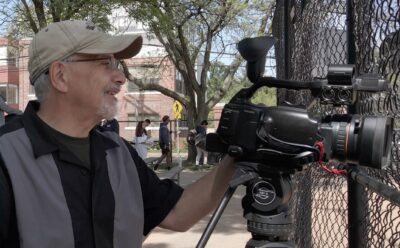 Filmed in summer 2023 through winter of 2024, Muchnik, who grew up nearby, and has many years of experience in the film industry, walked around the park with his iPhone, as well as took footage with his drone and a more conventional movie camera. But why focus on Danehy Park?
Muchnik says, “I had been coming out of a very agitated period in my life where I had work issues, I developed (and) had to learn how to deal with tinnitus. One of the things that I took away from that period in my life, a period coming out of COVID, a period of isolation, a period of personal and professional challenges, the death of my father, the end of a relationship (was) the need to connect.”
He continues, “I began asking myself who my neighbors were and what they did and how they lived. And, you know, it’s so mysterious when you get up, and then when you look out the window and you see that person walking their dog, year after year, you say, ‘Who is that person? (W)ho is that dog? Where do they live? Who are their friends?’ And then you don’t even realize it, but one day, that person is gone…(T)here are always people who come and go, and there are new faces and old faces, but you don’t notice it unless you really are looking for it.”
“The park was a kind of a lifeline to me, (and) what I very quickly learned is that if approached carefully with care, empathy and judiciously, people will open up. They do want to share their story. They are interested in being heard. They do want to contribute… And my sort of revelation was that parks are really good for people’s mental health. Parks are really open spaces (and) are really important to people, not just me in terms of my own itinerary, but to general urban wellness, or well-being. They have a huge remedial effect on people’s lives.”
Muchnik says, “They have an ability to bring down barriers between people. People were far more approachable at Danehy than they were when I’m trying to do man-on-the-street interviews in Harvard Square, trying to get people to talk about Topic A, Topic B. People are far more closed in an urban setting than they are in a park. It has to do with the possibility of escape. You’re in an open space, and people aren’t as threatened. They’re not as backed up against a corner, you know?”
 |
 |
 |
A little history of Danehy Park
Named after Mayor Thomas W. Danehy (1978-79), the park is 50 acres that extend from north Cambridge almost to Fresh Pond. According to the City of Cambridge’s website, it was an area for brickmaking from 1847-1952, then became a landfill until 1971. Through the 1970s-1980s, it was a place for Massachusetts Bay Transportation Authority (MBTA) Red Line waste. Finally it was opened as a park in 1990.
There are baseball, softball and soccer fields. There is a multi-use path and a track. There are rolling lawns and some untended meadow.
Muchnik notes the park even has a “Miyawaki forest of domestic and regional plant life. It was the first of its kind in Cambridge, probably in the region. It’s a connection between Fresh Pond and Porter Square. It is the route that everybody takes when they go for their runs around Fresh Pond. And it just became obvious that this place that I had been biking to when I was ten with my Stingray bike going over this landfill has turned into just a gorgeous, gorgeous space.”
There’s no trace on the surface of the park’s former role as a landfill. But it is still there. Muchnik says, “There is a large methane deposit because of the refuse underneath,” and the city has “installed methane taps to diffuse and to control” it.
Who’s at the park?
Turns out, a lot of people.
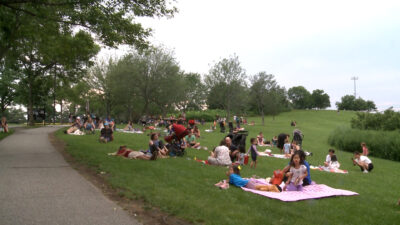
On sunny days, picnic blankets with couples on them abound as Muchnik makes his way around the park. There are several, including Sayeli and Pushka, who tell him “how they met and what the park means to them.”
Muchnik takes his time with each of the people or groups he includes. He says he talked to “people with handicaps, people with illness and people in mourning.” There is a man with an elderly dog in a stroller and another steering a remote control dog robot.
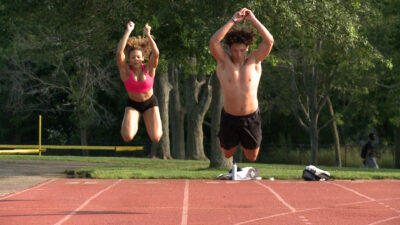
Muchnik says, “I see these kids playing soccer. They’re being trained to learn about teamwork and that happens. That happens at Danehy Park. That happens for Ultimate Frisbee. It happens for baseball. It happens for all the sports, really. And I just really became this advocate for open spaces as a result of that.”
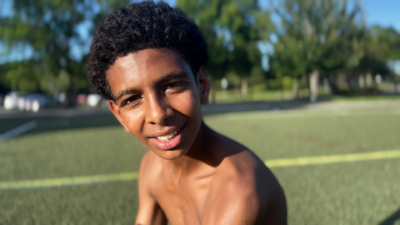
The value of teamwork isn’t the only message learned on these fields. Muchnik talks to several kids playing soccer, including one boy who Muchnik says, “must be 11 or 12. He’s Ethiopian…He lives across the street in public housing. Some of these kids, (when you ask about) soccer and what it means to them and what matters to them; this kid says, ‘family, my mother, my school.’ It’s a very uplifting interview. But then he also goes into watching his older teenage friends (around age) 15 being racially profiled by the cops and a lot of these black kids have strategies. They’ve educated themselves to have an answer, to be prepared for being profiled, the older ones, and that includes, you know, following orders, not being antagonistic with the police, and just being cool, staying calm and collected.”
These are just some of the people Muchnik meets with his camera. He says, “(Y)ou’ll take away what connects with, what reaches you. It might not be any of what I’ve said, but might be something else, but everybody walks away with a different part of the film.”