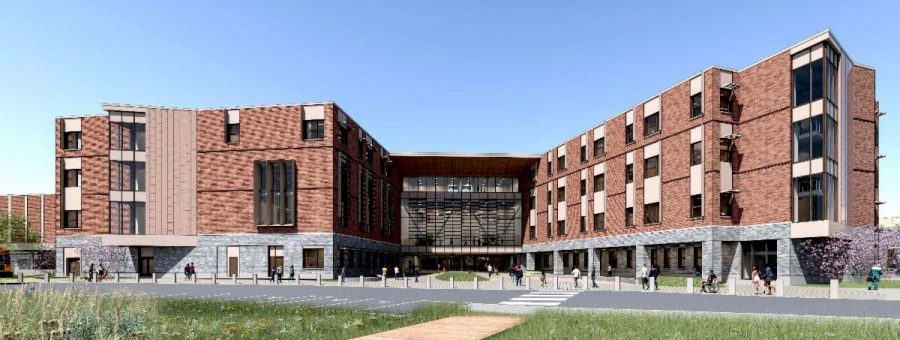
UPDATE: School Building Committee Reviews Proposals to Reduce Costs
Targeting costs and comparisons: School Building Committee reviews proposals to reduce costs without compromising function.
T his Monday, December 8, is the big day. Voters will give the thumbs-up or thumbs-down to fund a new high school for Lexington, known as the Bloom design, through a debt exclusion. In the meantime, the School Building Committee (SBC) is working with the design team to look for cost reductions.
OPM Mike Burton said, “The Lexington community now has its own decision to make based on its facility needs, educational priorities, and eligibility for MSBA funding.”
The School Building Committee met with the design team on November 17, 2025, to review proposed cost reductions. They looked at changes to the building structure and exterior features, as well as to the roadways and areas pedestrians would encounter. Later that day, Joe Pato, who sits on the SBC and is a Select Board member, provided an updated report to the Select Board on the process.
In his report, Pato emphasized the difference between Value Engineering, which includes reducing the scope of the project, and the ongoing Total Value Design. He states:
“It was reinforced [at the November 17 SBC meeting] that the TVD (Total Value Design) process differs from simple Value Engineering in that it seeks to find more efficient or improved implementation techniques that span multiple disciplines, rather than just scope reductions often associated with value engineering. So, there will be value engineering, and there is this continuing TVD process that looks like it is bearing fruit.”
Pato writes,” This process has identified over $500,000 worth of cost reductions through improved site work and structural elements. This is early progress in the TVD process, and more is expected as we move forward.” (See slide).
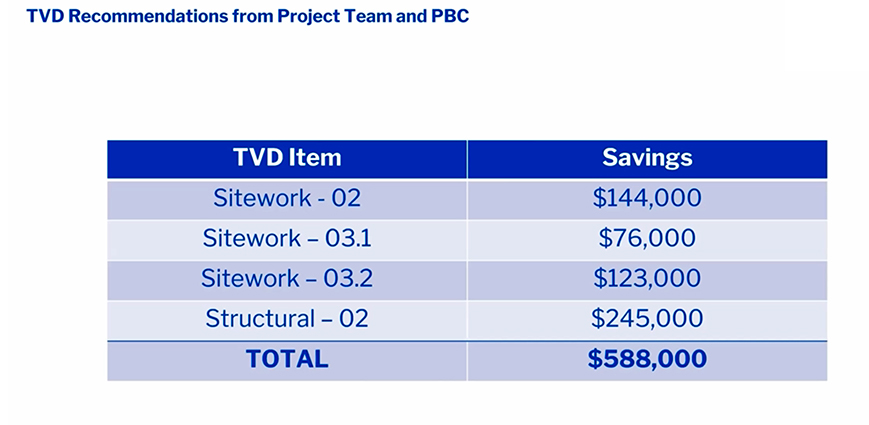
SBC members agreed that the design team should continue in this direction of finding where they can reduce costs. With the original target already met, as SBC and Permanent Building Committee, Charles Favazzo said any more reductions “is all gravy.”
Some changes improve the design for abutters at no extra cost.
Michael Dowhan, senior associate and landscape architect with SMMA, outlined a change to the layout of the Crumb football field, the practice field, and the cricket overlay (C5, C6, and C8 on accompanying slide). Dowhan said, “We received some feedback from both the abutters and internally from Naomi (Naomi Martin, Director of Athletics) and from Melissa (Melissa Batitte, Director of Recreation and Community Programs), 〈and〉 we’ve landed on a slight iteration…taking those three fields, [and] rotating them 90 degrees, counterclockwise. We think that helps a lot, not only just for the abutters, but also for the overall layout.”
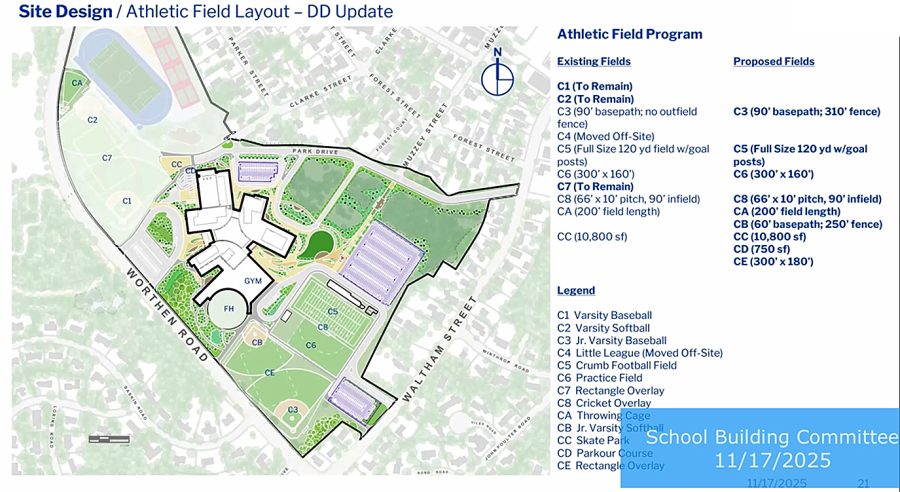
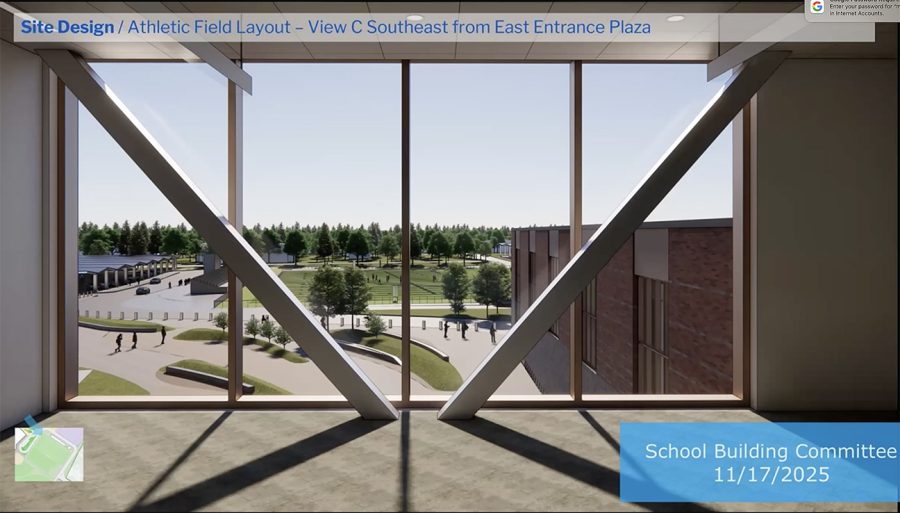
Referring to this change in field orientation later that day at a Select Board meeting, Joe Pato said, “This would move the concession stand and the grandstands from being parallel to the abutters to being perpendicular to abutters and not creating as much of a visual impact.” (See slide )
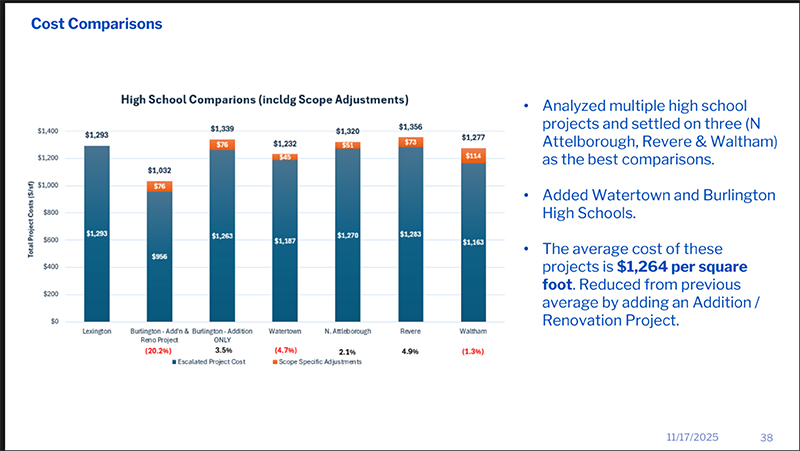 COST COMPARISONS CONTINUE: Local high school rebuilds and renovations
The SBC asked the design team to address ongoing questions about why Lexington’s high school project is $660 million, of which Lexington will pay about $540 million ($121 million is grant monies from the Massachusetts School Building Authority).
Mike Burton, Owner’s Project Manager (OPM) from Dorr+Whittier, described how Burlington’s addition/renovation high school project, which voters did not approve, differs from Lexington’s. He said the “Burlington project was a true addition/renovation project that retained two large gyms, a large auditorium, and around 100,000 square feet of existing building, while adding a new academic wing, and had very limited site work. In contrast, Lexington’s project, aside from the Field House renovation, is new construction. Lexington’s educational program is unique. The student enrollments greatly differ. We are at 2,395 versus Burlington’s 1,000, and Lexington’s larger site package all drive the difference in overall project size, cost, and scope.”
Burlington’s proposed project was entirely funded by the town, without MSBA (Massachusetts School Building Authority) funding. Voters rejected the project in a special election on November 15, 2025.
Kate Cassen of Turner Construction presented slides comparing the costs of area high schools. None of the projects was precisely the same in scope—the parcels were smaller, the energy systems were different, or the projects included renovation rather than new construction. Burlington’s per-square-foot cost estimate was for the proposed new addition alone.
Cost comparisons for nearby towns:
-Watertown $1232 per square foot
-Burlington was $1,339 sq. ft. for *new addition
-Lexington is $1293 sq. ft.
SBC Community Rep. Kseniya Slavsky confirmed that Bloom’s current costs do not include “offset” costs, such as rebates. However, she pointed out that adopting energy-efficient design now is the “responsible” approach. She said, “〈I〉f we were doing anything less right now, then when it came time to permit this project, we might have to be spending a lot of time and money to redesign.”
What looks like an optional energy system now may not be later. As Lorraine Finnegan, principal at SMMA, said, “A lot of the components that are currently in the opt-in stretch code will become basic energy code in the Massachusetts amendments.”
Overall, the SBC’s goal is to reduce costs without compromising functionality. In a discussion about moving columns at classroom entrances to the middle of the wall so there would be fewer of them, but by virtue of location, they would support a greater load, SBC Chair Kathleen Lenihan asked, based on “〈O〉ur previous iteration of where the columns were, does this impact the classroom…the size of the classroom? Any shapes?” SMMA architect Brian Black said the change in column locations would not impact the classrooms.
The target value design process will yield some proposed changes. Nothing was finalized at the November 17, 2025, meeting, but this process will continue if the debt exclusion vote shows Lexington residents want to proceed with the BLOOM design.
OPM Mike Burton said, “The Lexington community now has its own decision to make based on its facility needs, educational priorities, and eligibility for MSBA funding.”
PROJECT WEBSITE